Guba.com: For the first time, an online video site not affiliated with Hollywood can sell movies, TV shows
By John BoudreauMercury News
Continuing Hollywood's dance with Bay Area tech companies, Warner Bros. announced Monday a partnership with online video site Guba.com to distribute new and vintage movies and TV shows.
The deal is the result of a yearlong courtship started by Guba's co-founder, 33-year-old Tom McInerney, who expects other studio agreements in coming months. People will be able to rent or buy video downloads on Guba, marking the first time a Web site not affiliated with a Hollywood company can offer both movies and TV shows, from new film releases such as ``Syriana'' and ``Harry Potter and the Goblet of Fire,'' to TV shows, such as ``Babylon 5'' and ``The Flintstones.''
The San Francisco company hopes to grow its catalog of titles every month. Television episodes will be sold starting at $1.79 per episode. Movie rental prices start at $1.99 and films released on the same date they are on DVD will sell for $19.99. Older films will be sold for $9.99.
After initially hesitating, Hollywood has rushed into the digital era and is gaining momentum. Analysts speculate Steve Jobs is working to line up a deal to add movies to Apple Computer's successful and trend-setting online iTunes music and video store.
Meanwhile, Movielink, an online service co-owned by five Hollywood studios, began offering download sales of some first-run and older movies in April. Sony and Lions Gate also sell films on CinemaNow, jointly owned by Microsoft, Lions Gate, Cisco Systems and Blockbuster. In May, Warner Bros. announced it had agreed to use file-sharing company BitTorrent in San Francisco to legally distribute films and shows online, though the rollout isn't expected until late summer, a BitTorrent spokeswoman said. And NBC will announce today it will use the video-sharing site YouTube to promote its fall television lineup.
A few giants
Ultimately, giants like Apple, Yahoo and Google, which have enormous audiences, will dominate online video, said Phil Leigh, president of research firm Inside Digital Media. They could use their size to drive for better deals, such as maybe a price of just $10 a movie, he added.
Warner Bros. began to take Guba seriously after it agreed to scrub its site of pirated Hollywood videos, said Jim Wuthrich, senior vice president of Warner Bros. Home Entertainment.
``They worked on cleaning up the illegitimate product in the network,'' he said. ``So it made sense for us to go forward with the deal.''
Said Tim Bajarin, president of research company Creative Strategies: ``If you do not have the ability to prove to Hollywood that you can handle their content securely and guarantee it cannot be pirated, you don't even get in the door.
Entertainment online, though, is very much in its nascent stage.
``I don't know how big this business will be on an industry basis, or for Guba specifically,'' Wuthrich said. ``We are in the experimental state. We are trying different models and different partners. I really don't know where we will be six months from now.''
Studios generally insist video rentals expire 24 hours after they are first viewed. They also will be reluctant to offer movies online before the traditional four-month theater run because that would disrupt longstanding relationships with cinema owners, Bajarin said.
Restricted DVDs
Under the Guba-Warner Bros. agreement, people will be able to make a copy of a video onto a DVD, but, because of industry licensing agreements, it can only be played on the computer from which it was burned. Wuthrich said he hopes consumers will be able to watch the copied DVDs with a DVD player within a year or so.
For McInerney, the Warner Bros. deal is a big payoff, professionally and personally.
About a year ago, McInerney decided the only way his relatively unknown, 8-year-old company could garner the business of studios was to immerse himself in Hollywood's culture. He rented a Beverly Hills penthouse and bought a Porsche 911 to cruise Hollywood Boulevard. To do business in Hollywood, it helps to hit the clubs and social scene. And so he did.
McInerney, an engineer who once worked for Apple and Sony, hopes the deal will increase the visibility of Guba, which had 900,000 visitors in May, according to Nielsen Media Research. (YouTube, the popular video-sharing site, had more than 20 million visitors last month.)
With a license agreement to distribute Hollywood videos, he said, Guba has a stronger business model than its competitors.
``Nobody is going to pay to see a kid falling off his skateboard or a dog riding a bicycle,'' McInerney said.
6.27.2006

6.26.2006
Warner Bros To Offer Content Online via Guba
Time Warner Inc.'s Warner Bros. has made a deal to distribute movies and TV shows online via Guba LLC's search engine and video-sharing community, Guba.com, in one of the first moves by a major studio to embrace user-generated content.
Until yesterday, Guba displayed videos submitted mostly by amateurs, along with some professionally created material such as music videos posted illegally on the site. Now, the site will sell movies such as "Harry Potter and the Goblet of Fire" along with TV shows such as "Babylon 5."
Studios and record labels have been struggling with how to embrace Internet distribution while fighting online piracy. While the technology lures studios with the promise of an expanded market -- people who would pay to watch more movies if they were easy to download -- it also allows easy online pilfering of movies, TV shows and other copyrighted content.
"The mistake of the [movie] industry has been to worry too much about piracy and not enough about providing easy, simple ways to find content legally online," says Thomas McInerney, chief executive officer and founder of Guba. He believes putting the titles in front of the 503,000 unique monthly visitors to Guba should drive sales and rentals of the titles. The number of visitors is far behind sites like MSN Video, with more than 16 million unique visitors, or YouTube.com, with more than 13 million, according to research firm comScore Networks Inc. Mr. McInerney believes even those who have illegally downloaded movies and shows in the past would be willing to pay for them on Guba.
New movies will cost $19.99 on Guba, and older titles will cost $9.99. The titles can be moved onto portable devices or streamed around the home. New titles can be rented for $2.99. Movies will be available to buy the same day they come out on DVD, while rentals will be available a few weeks later.
Alongside the legal Warner titles, Guba users can find unapproved material, such as videos from Beyoncé and Madonna, and TV content like Oprah Winfrey's spoof on "Desperate Housewives," which aired last year. Guba says it has a technology called "Johnny" that searches for videos and other copyrighted material and removes those clips from the site, but it is a work in progress. The filter system is being constantly updated to catch more copyrighted content.
Warner has been working to ensure its creations are available in as many corners of the Web as possible. Last month, it cut a deal with BitTorrent Inc. to sell and rent movies using that company's peer-to-peer technology.
At the start of the year, Warner Bros., Bertelsmann AG and its subsidiary Arvato announced a service for the German market that relies on peer-to-peer technology called In2Movies. In the U.S., Warner launched In2TV, an advertising-supported service that allows viewers to watch classic TV shows free online.
Until yesterday, Guba displayed videos submitted mostly by amateurs, along with some professionally created material such as music videos posted illegally on the site. Now, the site will sell movies such as "Harry Potter and the Goblet of Fire" along with TV shows such as "Babylon 5."
Studios and record labels have been struggling with how to embrace Internet distribution while fighting online piracy. While the technology lures studios with the promise of an expanded market -- people who would pay to watch more movies if they were easy to download -- it also allows easy online pilfering of movies, TV shows and other copyrighted content.
"The mistake of the [movie] industry has been to worry too much about piracy and not enough about providing easy, simple ways to find content legally online," says Thomas McInerney, chief executive officer and founder of Guba. He believes putting the titles in front of the 503,000 unique monthly visitors to Guba should drive sales and rentals of the titles. The number of visitors is far behind sites like MSN Video, with more than 16 million unique visitors, or YouTube.com, with more than 13 million, according to research firm comScore Networks Inc. Mr. McInerney believes even those who have illegally downloaded movies and shows in the past would be willing to pay for them on Guba.
New movies will cost $19.99 on Guba, and older titles will cost $9.99. The titles can be moved onto portable devices or streamed around the home. New titles can be rented for $2.99. Movies will be available to buy the same day they come out on DVD, while rentals will be available a few weeks later.
Alongside the legal Warner titles, Guba users can find unapproved material, such as videos from Beyoncé and Madonna, and TV content like Oprah Winfrey's spoof on "Desperate Housewives," which aired last year. Guba says it has a technology called "Johnny" that searches for videos and other copyrighted material and removes those clips from the site, but it is a work in progress. The filter system is being constantly updated to catch more copyrighted content.
Warner has been working to ensure its creations are available in as many corners of the Web as possible. Last month, it cut a deal with BitTorrent Inc. to sell and rent movies using that company's peer-to-peer technology.
At the start of the year, Warner Bros., Bertelsmann AG and its subsidiary Arvato announced a service for the German market that relies on peer-to-peer technology called In2Movies. In the U.S., Warner launched In2TV, an advertising-supported service that allows viewers to watch classic TV shows free online.
Google Begins Streaming Free Videos
Google Inc. Thursday began streaming commercial videos, including movies and TV shows, for free on the Web as part of a trial of advertising support for its video offerings.
Google's move is a key test of how online ads can finance consumer access to premium video content on the Web, the way TV commercials have supported broadcast television for decades. It could impact the efforts of companies such as Apple Computer Inc. to charge users fees to access popular videos from the Internet. If successful, the video advertising could eventually develop into a significant new extension of Google's ad system that generated over $6 billion in revenue last year.
Owners of the videos included in the Google trial usually charged for the thousands of videos now available for free on the Google Video site (video.google.com). Google shared in the fees they previously collected.
Videos now accessible for free include movies such as Charlie Chaplin classics that previously cost 99 cents, episodes of the Mr. Magoo cartoon series that had cost $1.99 and wrestling matches that were $4.95.
Small graphical ads for advertisers including Burger King and Netflix appear above the videos, with short video commercials for them at the end of featured video content. Google said that fewer than 10 advertisers were currently involved in the test.
Google executives had previously said they were looking into ways to provide ad-supported commercial video. Many of the premium videos available through Google Video still carry fees.
Google's move is a key test of how online ads can finance consumer access to premium video content on the Web, the way TV commercials have supported broadcast television for decades. It could impact the efforts of companies such as Apple Computer Inc. to charge users fees to access popular videos from the Internet. If successful, the video advertising could eventually develop into a significant new extension of Google's ad system that generated over $6 billion in revenue last year.
Owners of the videos included in the Google trial usually charged for the thousands of videos now available for free on the Google Video site (video.google.com). Google shared in the fees they previously collected.
Videos now accessible for free include movies such as Charlie Chaplin classics that previously cost 99 cents, episodes of the Mr. Magoo cartoon series that had cost $1.99 and wrestling matches that were $4.95.
Small graphical ads for advertisers including Burger King and Netflix appear above the videos, with short video commercials for them at the end of featured video content. Google said that fewer than 10 advertisers were currently involved in the test.
Google executives had previously said they were looking into ways to provide ad-supported commercial video. Many of the premium videos available through Google Video still carry fees.
6.21.2006
PEEKABOO TV
PEEKABOO TV
http://www.peekabootv.com/index.aspx?cid=-1&home=true&
Business Model : Uploading content is completely free, other than the standard network operator charge. Any web and mobile phone users can download content using their mobile or the internet. The operators make money from the data traffic, as users access and download content. As a reward for generating the content in the first place, the user is paid each time their clips are downloaded.
PeekaBooTV also acts as a storage place for user's photos and other content. To stop phones getting full users can just upload the content to their PeekaBooTV channel and store them, either privately or allowing people to see them.
The PeekaBooTV architecture has been designed to allow Mobile Network Operators to easily and efficiently add the functionality to their on-portal services, allowing users to be rewarded directly through their phone bills or by a separate payment. PeekaBooTV is actively seeking MNO partnerships. PeekaBooTVis a Limited company in the United Kingdom. PeekaBooTV technology is powered by the DA Group in Scotland.
PeekaBooTV can be thought of as a personal TV show, accessible from mobile phones (and PCs), where users upload the videos they've made; saucy, funny, gross or just plain entertaining, and whenever anyone else downloads it, they make cash. The service works on almost all handsets and any mobile network. Although it's predominately a mobile video solution, it is not a 3G reliant service, greatly increasing the potential user community.
Media companies or web communities, such as magazine publishers for example, can have their own branded versions of the PeekaBooTV web and wap portals, complete with the magazines branding. This allows their readers to interact with other members of their own community and also the wider database of PeekaBooTV content. It gives publishers a new dimension in reaching their target audience and in the case on monthly publications makes sure there is branded interaction with their target audience between issues.
Users can monitor how their clips are doing and how much cash or credits they have earned instantly from a range of pie charts that illustrate their earnings. The amount of cash users can earn is unlimited and uploads can be done over the web. PeekaBooTV Content is grouped by category, such as funny, wacky, sexy, gross etc. All content is moderated before being published, so users need to take care to stick to the terms and conditions when uploading videos or they won't be published.
PeekabooTV is a quick safe way to publish work while also reaping the rewards." "PeekaBooTV takes this to the next level, making everyone a publisher of their own work. Whether they are in front of the camera or behind it the user has the power to publish their own thoughts, views, music or reports. "People do business with other people. We've already seen an explosion in personal commerce with businesses dealing direct with the consumer through the web and on more personal level sites like eBay making everyone a shopkeeper. User Generated, and User Rewarded, PBTV points the way to the future of user generated content."
http://www.peekabootv.com/index.aspx?cid=-1&home=true&
Business Model : Uploading content is completely free, other than the standard network operator charge. Any web and mobile phone users can download content using their mobile or the internet. The operators make money from the data traffic, as users access and download content. As a reward for generating the content in the first place, the user is paid each time their clips are downloaded.
PeekaBooTV also acts as a storage place for user's photos and other content. To stop phones getting full users can just upload the content to their PeekaBooTV channel and store them, either privately or allowing people to see them.
The PeekaBooTV architecture has been designed to allow Mobile Network Operators to easily and efficiently add the functionality to their on-portal services, allowing users to be rewarded directly through their phone bills or by a separate payment. PeekaBooTV is actively seeking MNO partnerships. PeekaBooTVis a Limited company in the United Kingdom. PeekaBooTV technology is powered by the DA Group in Scotland.
PeekaBooTV can be thought of as a personal TV show, accessible from mobile phones (and PCs), where users upload the videos they've made; saucy, funny, gross or just plain entertaining, and whenever anyone else downloads it, they make cash. The service works on almost all handsets and any mobile network. Although it's predominately a mobile video solution, it is not a 3G reliant service, greatly increasing the potential user community.
Media companies or web communities, such as magazine publishers for example, can have their own branded versions of the PeekaBooTV web and wap portals, complete with the magazines branding. This allows their readers to interact with other members of their own community and also the wider database of PeekaBooTV content. It gives publishers a new dimension in reaching their target audience and in the case on monthly publications makes sure there is branded interaction with their target audience between issues.
Users can monitor how their clips are doing and how much cash or credits they have earned instantly from a range of pie charts that illustrate their earnings. The amount of cash users can earn is unlimited and uploads can be done over the web. PeekaBooTV Content is grouped by category, such as funny, wacky, sexy, gross etc. All content is moderated before being published, so users need to take care to stick to the terms and conditions when uploading videos or they won't be published.
PeekabooTV is a quick safe way to publish work while also reaping the rewards." "PeekaBooTV takes this to the next level, making everyone a publisher of their own work. Whether they are in front of the camera or behind it the user has the power to publish their own thoughts, views, music or reports. "People do business with other people. We've already seen an explosion in personal commerce with businesses dealing direct with the consumer through the web and on more personal level sites like eBay making everyone a shopkeeper. User Generated, and User Rewarded, PBTV points the way to the future of user generated content."
MTV bets big on digital strategies
MTV, once the frontrunner in music television, is now playing catch-up with the iPod generation. As its target demographic increasingly looks to mobile, broadband and video-on-demand services for its content, MTV is being forced to step up its digital activities.
At its annual sales presentation in New York earlier this month, the Viacom-owned broadcaster outlined plans to increase revenue generated by new platforms from its current $150 million to $500 million by 2008.
"With each platform we are trying to expand our reach and increase our income," Angel Gambino, the vice-president for commercial strategy and digital media at MTV Networks UK, says. "It's about extending our channels and our brands to new and other platforms, and into newer areas, such as MTV Overdrive into broadband."
In addition to mobile TV channels for the MTV, Nickelodeon, Paramount Comedy and Game One brands across Europe, MTV's broadband suite includes Nicke-lodeon's Turbo-Nick, VH1's V Spot, Comedy Central's Motherload, MTV U's Uber, CMT's Loaded and its newest addition, MTV Overdrive.
Launched in the UK last month, MTV Overdrive is an online free-to-view, on-demand service, offering viewers clips from MTV shows such as Pimp My Ride, as well as news, movie trailers and music videos.
Along with repackaged popular programmes from its linear channels, MTV's broadband and mobile services offer extras from original series and bespoke digital content.
"While shooting shows for our broadcast channels, our production crews are now also briefed to shoot extra footage so that it can be delivered to mobile or PC," Dan Whiley, the commercial vice-president of digital media at MTV Networks International, says.
"We release two to three original made-for-digital series per year and make one hour of made-for-mobile content and one hour of made-for-broadband content every week. We also create eight to ten mobile games and up to 300 mobile downloads, such as ringtones and graphics, every year."
Gambino believes that these media platforms could also provide MTV Networks, which attracts 1.3 billion viewers worldwide, with a useful testing ground for new programming.
"When we are unsure how something might work, it allows us to use these platforms as an incubation area to build up some critical mass and then find it the right place in the TV schedule," she says, pointing to the upcoming transition of the street-culture show Barrio 19 from mobile to network.
MTV is also fine-tuning its digital strategy to accommodate the increasing popularity of social networks and user-generated content sites such as MySpace and YouTube. Viacom has been busy creating the online music service MTV Urge for launch in the US this month. It has also acquired the online film distributor IFILM, the virtual pet community Neopets and the gaming properties Gametrailers and Xfire.
Meanwhile, MTV has been putting the finishing touches to a new crossplatform channel aimed at its web-savvy audience. "It's completely community- and user-controlled TV," Gambino says of the as-yet-unnamed service, which is due to launch later this year.
"You create your own playlist and are able to get your content up on screen. It ties together social networking, video-on-demand and user-generated content." She also maintains that the new crossplatform channel will offer advertisers a more efficient showcase. "A lot of advertisers spend a lot on TV advertising," she says. "This will give them the opportunity to take an integrated approach."
While MySpace, Google and YouTube have undoubtedly made an impact online, Whiley believes MTV has a clear advantage in this new space. "We've been entertaining youth and adult audiences for a long time," he says. "This puts us in a great position with our audiences, and we really don't view these sites as direct competitors."
It is precisely this longevity that may ultimately attract advertisers to MTV's digital offshoots. "The demographics aren't radically different from people watching the TV channels, but, if the advertising is done properly, advertisers gain premium content to associate themselves with and the benefit of targeting," Dan Cryan, an analyst at the media market research publication Screen Digest, says.
Mat Mildenhall, the chief operating officer at Proximity, agrees. "MTV will not have the scale of Yahoo!, but it will be a much narrower audience," he says. "If you are a trusted brand, you need to be careful how you operate in that space in terms of spam and intrusion, but most people will be gleeful to get MTV content."
So far, MTV has seen almost all its big sponsors, such as Adidas and Sony, advertise with it online and others are likely to follow suit. "MTV has a strong brand which will attract a decent-sized, youth, fashion-orientated audience," Julian Smith, an online advertising analyst at JupiterResearch, says.
As well as being a significant revenue source for MTV, online advertising could also help to build a social network around its digital content.
"MTV has a well-established community which is happy to contribute and participate online," Smith says. "Interactivity is a great way to generate revenue and maintain audience loyalty." MTV is also hoping that this drive into digital media will help take the brand into new territories.
With Europe already a stronghold - the region's digital activities yield the fastest growth rates for MTV's international business - Gambino is looking to push further afield. "We'll start to see a lot more digital growth in countries where our TV business is less mature," she says. "We'll use that as our lead."
(c) 2006 The Times of India Group. All rights reserved.
At its annual sales presentation in New York earlier this month, the Viacom-owned broadcaster outlined plans to increase revenue generated by new platforms from its current $150 million to $500 million by 2008.
"With each platform we are trying to expand our reach and increase our income," Angel Gambino, the vice-president for commercial strategy and digital media at MTV Networks UK, says. "It's about extending our channels and our brands to new and other platforms, and into newer areas, such as MTV Overdrive into broadband."
In addition to mobile TV channels for the MTV, Nickelodeon, Paramount Comedy and Game One brands across Europe, MTV's broadband suite includes Nicke-lodeon's Turbo-Nick, VH1's V Spot, Comedy Central's Motherload, MTV U's Uber, CMT's Loaded and its newest addition, MTV Overdrive.
Launched in the UK last month, MTV Overdrive is an online free-to-view, on-demand service, offering viewers clips from MTV shows such as Pimp My Ride, as well as news, movie trailers and music videos.
Along with repackaged popular programmes from its linear channels, MTV's broadband and mobile services offer extras from original series and bespoke digital content.
"While shooting shows for our broadcast channels, our production crews are now also briefed to shoot extra footage so that it can be delivered to mobile or PC," Dan Whiley, the commercial vice-president of digital media at MTV Networks International, says.
"We release two to three original made-for-digital series per year and make one hour of made-for-mobile content and one hour of made-for-broadband content every week. We also create eight to ten mobile games and up to 300 mobile downloads, such as ringtones and graphics, every year."
Gambino believes that these media platforms could also provide MTV Networks, which attracts 1.3 billion viewers worldwide, with a useful testing ground for new programming.
"When we are unsure how something might work, it allows us to use these platforms as an incubation area to build up some critical mass and then find it the right place in the TV schedule," she says, pointing to the upcoming transition of the street-culture show Barrio 19 from mobile to network.
MTV is also fine-tuning its digital strategy to accommodate the increasing popularity of social networks and user-generated content sites such as MySpace and YouTube. Viacom has been busy creating the online music service MTV Urge for launch in the US this month. It has also acquired the online film distributor IFILM, the virtual pet community Neopets and the gaming properties Gametrailers and Xfire.
Meanwhile, MTV has been putting the finishing touches to a new crossplatform channel aimed at its web-savvy audience. "It's completely community- and user-controlled TV," Gambino says of the as-yet-unnamed service, which is due to launch later this year.
"You create your own playlist and are able to get your content up on screen. It ties together social networking, video-on-demand and user-generated content." She also maintains that the new crossplatform channel will offer advertisers a more efficient showcase. "A lot of advertisers spend a lot on TV advertising," she says. "This will give them the opportunity to take an integrated approach."
While MySpace, Google and YouTube have undoubtedly made an impact online, Whiley believes MTV has a clear advantage in this new space. "We've been entertaining youth and adult audiences for a long time," he says. "This puts us in a great position with our audiences, and we really don't view these sites as direct competitors."
It is precisely this longevity that may ultimately attract advertisers to MTV's digital offshoots. "The demographics aren't radically different from people watching the TV channels, but, if the advertising is done properly, advertisers gain premium content to associate themselves with and the benefit of targeting," Dan Cryan, an analyst at the media market research publication Screen Digest, says.
Mat Mildenhall, the chief operating officer at Proximity, agrees. "MTV will not have the scale of Yahoo!, but it will be a much narrower audience," he says. "If you are a trusted brand, you need to be careful how you operate in that space in terms of spam and intrusion, but most people will be gleeful to get MTV content."
So far, MTV has seen almost all its big sponsors, such as Adidas and Sony, advertise with it online and others are likely to follow suit. "MTV has a strong brand which will attract a decent-sized, youth, fashion-orientated audience," Julian Smith, an online advertising analyst at JupiterResearch, says.
As well as being a significant revenue source for MTV, online advertising could also help to build a social network around its digital content.
"MTV has a well-established community which is happy to contribute and participate online," Smith says. "Interactivity is a great way to generate revenue and maintain audience loyalty." MTV is also hoping that this drive into digital media will help take the brand into new territories.
With Europe already a stronghold - the region's digital activities yield the fastest growth rates for MTV's international business - Gambino is looking to push further afield. "We'll start to see a lot more digital growth in countries where our TV business is less mature," she says. "We'll use that as our lead."
(c) 2006 The Times of India Group. All rights reserved.
6.20.2006
The Next Net 25
A new Web revolution is picking up steam, and the next Google or Microsoft could emerge from the companies that are in the vanguard.
SAN FRANCISCO (Business 2.0 Magazine) - Things are really crackling in Silicon Valley these days. There's the frenzied startup action, the rising rivers of VC cash, even the occasional bubble-icious long-term stock prediction (Google $2,000, anyone?).
There's so much happening that the buzzword recently employed to try to encapsulate the era -- "Web 2.0" -- now seems hopelessly inadequate, defined and redefined into near meaninglessness by squadrons of aspiring entrepreneurs, marketers, and other fortune hunters.
So it seems a particularly useful moment to wave away the smoke and home in on what's really core. Don't be distracted by the Valley's hype-o-meter pushing toward the red: There's something very real -- and very powerful -- afoot.
Driven by ubiquitous broadband, cheap hardware, and open-source software, the Web is mutating into a radically different beast than it has been. And that is leading to the creation of entirely new kinds of companies, new business models, and oceans of new opportunity.
We are in the early stages of what might be better thought of as the Next Net. The Next Net will encompass all digital devices, from PC to cell phone to television. Its defining characteristics include the ability to interact instantaneously with any of the more than 1 billion Web users across the globe -- not by, say, instant messaging, but by evolving instant-voice-messaging and instant-video-messaging apps that will make today's e-mail and IM seem crude.
The Next Net is deeply collaborative: People from across the planet can work together on the same task, and products or tools can be rapidly tweaked and improved by the collective wisdom of the entire online world.
The new era is also creating a realm of endless mix and match: Anyone with a browser can access vast stores of information, mash it up, and serve it in new ways, to a few people or a few hundred million.
Most striking, the Next Net creates endless possibilities for entrepreneurs and established players alike to take advantage of the Web's new power. They are building on the success of early standard-bearers -- Flickr, MySpace, Wikipedia -- but also moving beyond those pioneers in creative and fascinating ways.
In the pages that follow, we identify 25 companies, in five Next Net categories, whose approaches help illuminate where the Web is headed and where the opportunities lie. Most are startups, a lot of them with less than 10 full-time employees. Few are currently making money, and it's a given that many will fail. But it's equally likely that somewhere within this group lurks the next Google or Microsoft or Yahoo -- or at least something that those giants will soon pay a pretty penny to have.
SOCIAL MEDIAThe new culture on the Web is all about consumer creation; it's composed of things like the nearly 30 million blogs out there and the 70 million photos available on Flickr. With a click of the mouse, anyone can be a journalist, a photographer, or a DJ. The audience -- that 1 billion-plus throng linked by the Web--itself is creating a new type of social media. That's leading to the creation of hundreds of promising Next Net businesses like the ones that follow.
SOCIAL MEDIACompany: Digg (San Francisco)What it is: News aggregatorNext Net bona fides: The site's links are picked by the readership, which has been doubling every three months; news items with the most votes make the homepage.
SOCIAL MEDIACompany: Last.fm (London)What it is: Social radioNext Net bona fides: Its software creates a personalized streaming radio station based on the digital music you already listen to, shares your playlist on the Web, and suggests music from other closely related playlists
SOCIAL MEDIACompany: Newsvine (Seattle)What it is: Collaborative publisherNext Net bona fides: Readers vote and comment on stories but can also organize their own pages and write their own stories, for which they collect 90 percent of associated ad revenues.
SOCIAL MEDIACompany: Tagworld (Santa Monica)What it is: Social networkingNext Net bona fides: With cutting-edge Web software enabling blogs, photo and music sharing, online dating, and more, members confront a rich smorgasbord of ways to interact, and everything can be tagged for easy searching.
SOCIAL MEDIACompany: YouTube (San Mateo, CA)What it is: Video sharingNext Net bona fides: This site lets people upload, watch, and share millions of video clips. All videos are converted to Flash (a Web-tailored format for graphics and video), making them easy to import into blogs or webpages.
Incumbent To Watch: Yahoo!Hoping to dominate social media, it's gobbling up promising startups (Del.icio.us, Flickr, Webjay) and experimenting with social search (My Web 2.0) that ranks results based on shared bookmarks and tags.
MASHUPS AND FILTERSAs we move toward the Next Net, some of the most useful sites will be those that either help "mash up" -- meaning mix and match -- content from other parts of the Web or act as a filter for the overwhelming mountains of information now at people's fingertips. The companies that follow use content already on the Web as a starting point and then improve on it by organizing it in a new way.
MASHUPS AND FILTERSCompany: Bloglines (Los Gatos, CA)What it is: Online feed readerNext Net bona fides: The site collects blogs and news from all over the Web and presents it in one consistent, updated, multifeed mashup
MASHUPS AND FILTERSCompany: Eurekster (San Francisco)What it is: Search mashupNext Net bona fides: This do-it-yourself search engine, or swicki, allows you to define sites you want to search, post the results on your blog or website, and get a cut of any search ads your audience clicks on
MASHUPS AND FILTERSCompany: Simply Hired (Mountain View, CA)What it is: Job search engineNext Net bona fides: It searches nearly 4.5 million listings on other job and corporate sites; subscribers receive an RSS feed or e-mail alert when a job that meets their parameters pops up.
MASHUPS AND FILTERSCompany: Technorati (San Francisco)What it is: Blog search engineNext Net bona fides: The site filters the almost 30 million existing blogs, shows how many other blogs link to a particular post, and can rank blogs by topic.
MASHUPS AND FILTERSCompany: Trulia (San Francisco)What it is: Real estate mashupNext Net bona fides: Combining home listings from agents' websites with Google Maps, the site is becoming a hit in California and is expanding into other regions.
MASHUPS AND FILTERSCompany: Wink (Mountain View, CA)What it is: Tag search engineNext Net bona fides: By searching user-generated tags on Next Net sites like Del.icio.us and Digg, Wink filters the Web so users can sort links into different collections and add their own tags and bookmarks.
MASHUPS AND FILTERSIncumbent To Watch: GoogleAlready the ultimate Web filter through general search as well as blog, news, shopping, and now video search, it's encouraging mashups of Google Maps and search results, and offers a free RSS reader.
THE NEW PHONEFor nearly a century, the phone, and voice as we know it, has existed largely in the confines of a thin copper wire. But now service providers can convert voice calls into tiny Internet packets and let them loose on fast connections, thus mimicking the traditional voice experience without spending hundreds of millions on infrastructure. All you need are powerful--but cheap--computers running specialized software. The Next Net will be the new phone, creating fertile ground for new businesses.
THE NEW PHONECompany: SIPphone (San Diego)What it is: Internet phone softwareNext Net bona fides: Its Gizmo Project application allows free PC-to-PC calls, cheap PC-to-phone calls, and sound effects.
THE NEW PHONEIncumbent To Watch: eBay (Skype)The pioneer in the field and still the front-runner, Skype brings together free calling, IM, and video calling over the Web; eBay will use it to create deeper connections between buyers and sellers.
THE WEBTOPIt's been a long time -- all the way back to the dawn of desktop computing in the early 1980s -- since software coders have had as much fun as they're having right now. But today, browser-based applications are where the action is. A killer app no longer requires hundreds of drones slaving away on millions of lines of code. Three or four engineers and a steady supply of Red Bull is all it takes to rapidly turn a midnight brainstorm into a website so hot it melts the servers. What has changed is the way today's Web-based apps can run almost as seamlessly as programs used on the desktop, with embedded audio, video, and drag-and-drop ease of use.
THE WEBTOPCompany: JotSpot (Palo Alto)What it is: Wikis and online spreadsheetsNext Net bona fides: A pioneer of Web collaboration apps, a.k.a. wikis, it has unveiled its new Tracker application, which provides a powerful, highly collaborative
THE WEBTOPCompany: 30Boxes (San Francisco)What it is: Online calendarNext Net bona fides: This Web-based software allows families and groups to create private social networks, organize events, track schedules, and share photos; it may soon allow you to save phone numbers as hyperlinks and make calls by simply clicking on a link.
THE WEBTOP
Company: 37Signals (Chicago)What it is: Online project managementNext Net bona fides: Its Basecamp app, elegant and inexpensive, enables the creation, sharing, and tracking of to-do lists, files, performance milestones, and other key project metrics; related app Backpack, recently released, is a powerful online organizer for individuals.
THE WEBTOPCompany: Writely (Portola Valley, CA)What it is: Online word processingNext Net bona fides: It enables online creation of documents, opens them to collaboration by anyone anywhere, and simplifies publishing the end result on a website as a blog entry
THE WEBTOPCompany: Zimbra (San Mateo, CA)What it is: Online e-mailNext Net bona fides: Taking aim at Microsoft Outlook, its Ajax-based application can, among other things, bring up your calendar for any date your mouse encounters, launch Skype for any phone number, or retrieve a Google map for any address.
THE WEBTOPIncumbent To Watch: MicrosoftBy rolling out Windows Live, Office Live, and other Next Net-centric software, it hopes to grab a dominant -- if not monopolistic -- share of the webtop, which Bill Gates regards as a crucial strategic priority.
UNDER THE HOOD A growing number of companies are either offering themselves as Web-based platforms on which other software and businesses can be built or developing basic tools that make some of the defining hallmarks of the Next Net possible.
UNDER THE HOODCompany: Brightcove (Cambridge, MA)What it is: Internet TV distributorNext Net bona fides: It's creating a video-distribution platform over the Web for producers large and small
UNDER THE HOODCompany: Jigsaw (San Mateo, CA)What it is: Business contact databaseNext Net bona fides: In exchange for their own contact lists, salespeople use this site to access a virtual Rolodex of managers at nearly 150,000 companies
UNDER THE HOODCompany: SimpleFeed (Palo Alto)What it is: Opt-in RSS marketingNext Net bona fides: By allowing RSS feeds to be customized to the desires of each recipient and tracked individually, the site makes such feeds a powerful marketing tool.
UNDER THE HOODCompany: Salesforce.com (San Francisco)What it is: Platform for online enterprise softwareNext Net bona fides: It pioneered Web-based software and is trying to become a marketplace and host for other online apps through its AppExchange.
UNDER THE HOODCompany: Six Apart (San Francisco)What it is: Blogging toolsNext Net bona fides: The company helped kick off and sustain the Next Net with its Moveable Type blogging software and TypePad blogging service.
UNDER THE HOODIncumbent To Watch: AmazonIt's becoming a major Web platform by opening up its software protocols and encouraging anyone to use its catalog and other data; its Alexa Web crawler, which indexes the Net, can be used as the basis for other search engines, and its Mechanical Turk site solicits humans across cyberspace to do things that computers still can't do well, such as identify images or transcribe podcasts.
SAN FRANCISCO (Business 2.0 Magazine) - Things are really crackling in Silicon Valley these days. There's the frenzied startup action, the rising rivers of VC cash, even the occasional bubble-icious long-term stock prediction (Google $2,000, anyone?).
There's so much happening that the buzzword recently employed to try to encapsulate the era -- "Web 2.0" -- now seems hopelessly inadequate, defined and redefined into near meaninglessness by squadrons of aspiring entrepreneurs, marketers, and other fortune hunters.
So it seems a particularly useful moment to wave away the smoke and home in on what's really core. Don't be distracted by the Valley's hype-o-meter pushing toward the red: There's something very real -- and very powerful -- afoot.
Driven by ubiquitous broadband, cheap hardware, and open-source software, the Web is mutating into a radically different beast than it has been. And that is leading to the creation of entirely new kinds of companies, new business models, and oceans of new opportunity.
We are in the early stages of what might be better thought of as the Next Net. The Next Net will encompass all digital devices, from PC to cell phone to television. Its defining characteristics include the ability to interact instantaneously with any of the more than 1 billion Web users across the globe -- not by, say, instant messaging, but by evolving instant-voice-messaging and instant-video-messaging apps that will make today's e-mail and IM seem crude.
The Next Net is deeply collaborative: People from across the planet can work together on the same task, and products or tools can be rapidly tweaked and improved by the collective wisdom of the entire online world.
The new era is also creating a realm of endless mix and match: Anyone with a browser can access vast stores of information, mash it up, and serve it in new ways, to a few people or a few hundred million.
Most striking, the Next Net creates endless possibilities for entrepreneurs and established players alike to take advantage of the Web's new power. They are building on the success of early standard-bearers -- Flickr, MySpace, Wikipedia -- but also moving beyond those pioneers in creative and fascinating ways.
In the pages that follow, we identify 25 companies, in five Next Net categories, whose approaches help illuminate where the Web is headed and where the opportunities lie. Most are startups, a lot of them with less than 10 full-time employees. Few are currently making money, and it's a given that many will fail. But it's equally likely that somewhere within this group lurks the next Google or Microsoft or Yahoo -- or at least something that those giants will soon pay a pretty penny to have.
SOCIAL MEDIAThe new culture on the Web is all about consumer creation; it's composed of things like the nearly 30 million blogs out there and the 70 million photos available on Flickr. With a click of the mouse, anyone can be a journalist, a photographer, or a DJ. The audience -- that 1 billion-plus throng linked by the Web--itself is creating a new type of social media. That's leading to the creation of hundreds of promising Next Net businesses like the ones that follow.
SOCIAL MEDIACompany: Digg (San Francisco)What it is: News aggregatorNext Net bona fides: The site's links are picked by the readership, which has been doubling every three months; news items with the most votes make the homepage.
SOCIAL MEDIACompany: Last.fm (London)What it is: Social radioNext Net bona fides: Its software creates a personalized streaming radio station based on the digital music you already listen to, shares your playlist on the Web, and suggests music from other closely related playlists
SOCIAL MEDIACompany: Newsvine (Seattle)What it is: Collaborative publisherNext Net bona fides: Readers vote and comment on stories but can also organize their own pages and write their own stories, for which they collect 90 percent of associated ad revenues.
SOCIAL MEDIACompany: Tagworld (Santa Monica)What it is: Social networkingNext Net bona fides: With cutting-edge Web software enabling blogs, photo and music sharing, online dating, and more, members confront a rich smorgasbord of ways to interact, and everything can be tagged for easy searching.
SOCIAL MEDIACompany: YouTube (San Mateo, CA)What it is: Video sharingNext Net bona fides: This site lets people upload, watch, and share millions of video clips. All videos are converted to Flash (a Web-tailored format for graphics and video), making them easy to import into blogs or webpages.
Incumbent To Watch: Yahoo!Hoping to dominate social media, it's gobbling up promising startups (Del.icio.us, Flickr, Webjay) and experimenting with social search (My Web 2.0) that ranks results based on shared bookmarks and tags.
MASHUPS AND FILTERSAs we move toward the Next Net, some of the most useful sites will be those that either help "mash up" -- meaning mix and match -- content from other parts of the Web or act as a filter for the overwhelming mountains of information now at people's fingertips. The companies that follow use content already on the Web as a starting point and then improve on it by organizing it in a new way.
MASHUPS AND FILTERSCompany: Bloglines (Los Gatos, CA)What it is: Online feed readerNext Net bona fides: The site collects blogs and news from all over the Web and presents it in one consistent, updated, multifeed mashup
MASHUPS AND FILTERSCompany: Eurekster (San Francisco)What it is: Search mashupNext Net bona fides: This do-it-yourself search engine, or swicki, allows you to define sites you want to search, post the results on your blog or website, and get a cut of any search ads your audience clicks on
MASHUPS AND FILTERSCompany: Simply Hired (Mountain View, CA)What it is: Job search engineNext Net bona fides: It searches nearly 4.5 million listings on other job and corporate sites; subscribers receive an RSS feed or e-mail alert when a job that meets their parameters pops up.
MASHUPS AND FILTERSCompany: Technorati (San Francisco)What it is: Blog search engineNext Net bona fides: The site filters the almost 30 million existing blogs, shows how many other blogs link to a particular post, and can rank blogs by topic.
MASHUPS AND FILTERSCompany: Trulia (San Francisco)What it is: Real estate mashupNext Net bona fides: Combining home listings from agents' websites with Google Maps, the site is becoming a hit in California and is expanding into other regions.
MASHUPS AND FILTERSCompany: Wink (Mountain View, CA)What it is: Tag search engineNext Net bona fides: By searching user-generated tags on Next Net sites like Del.icio.us and Digg, Wink filters the Web so users can sort links into different collections and add their own tags and bookmarks.
MASHUPS AND FILTERSIncumbent To Watch: GoogleAlready the ultimate Web filter through general search as well as blog, news, shopping, and now video search, it's encouraging mashups of Google Maps and search results, and offers a free RSS reader.
THE NEW PHONEFor nearly a century, the phone, and voice as we know it, has existed largely in the confines of a thin copper wire. But now service providers can convert voice calls into tiny Internet packets and let them loose on fast connections, thus mimicking the traditional voice experience without spending hundreds of millions on infrastructure. All you need are powerful--but cheap--computers running specialized software. The Next Net will be the new phone, creating fertile ground for new businesses.
THE NEW PHONECompany: SIPphone (San Diego)What it is: Internet phone softwareNext Net bona fides: Its Gizmo Project application allows free PC-to-PC calls, cheap PC-to-phone calls, and sound effects.
THE NEW PHONEIncumbent To Watch: eBay (Skype)The pioneer in the field and still the front-runner, Skype brings together free calling, IM, and video calling over the Web; eBay will use it to create deeper connections between buyers and sellers.
THE WEBTOPIt's been a long time -- all the way back to the dawn of desktop computing in the early 1980s -- since software coders have had as much fun as they're having right now. But today, browser-based applications are where the action is. A killer app no longer requires hundreds of drones slaving away on millions of lines of code. Three or four engineers and a steady supply of Red Bull is all it takes to rapidly turn a midnight brainstorm into a website so hot it melts the servers. What has changed is the way today's Web-based apps can run almost as seamlessly as programs used on the desktop, with embedded audio, video, and drag-and-drop ease of use.
THE WEBTOPCompany: JotSpot (Palo Alto)What it is: Wikis and online spreadsheetsNext Net bona fides: A pioneer of Web collaboration apps, a.k.a. wikis, it has unveiled its new Tracker application, which provides a powerful, highly collaborative
THE WEBTOPCompany: 30Boxes (San Francisco)What it is: Online calendarNext Net bona fides: This Web-based software allows families and groups to create private social networks, organize events, track schedules, and share photos; it may soon allow you to save phone numbers as hyperlinks and make calls by simply clicking on a link.
THE WEBTOP
Company: 37Signals (Chicago)What it is: Online project managementNext Net bona fides: Its Basecamp app, elegant and inexpensive, enables the creation, sharing, and tracking of to-do lists, files, performance milestones, and other key project metrics; related app Backpack, recently released, is a powerful online organizer for individuals.
THE WEBTOPCompany: Writely (Portola Valley, CA)What it is: Online word processingNext Net bona fides: It enables online creation of documents, opens them to collaboration by anyone anywhere, and simplifies publishing the end result on a website as a blog entry
THE WEBTOPCompany: Zimbra (San Mateo, CA)What it is: Online e-mailNext Net bona fides: Taking aim at Microsoft Outlook, its Ajax-based application can, among other things, bring up your calendar for any date your mouse encounters, launch Skype for any phone number, or retrieve a Google map for any address.
THE WEBTOPIncumbent To Watch: MicrosoftBy rolling out Windows Live, Office Live, and other Next Net-centric software, it hopes to grab a dominant -- if not monopolistic -- share of the webtop, which Bill Gates regards as a crucial strategic priority.
UNDER THE HOOD A growing number of companies are either offering themselves as Web-based platforms on which other software and businesses can be built or developing basic tools that make some of the defining hallmarks of the Next Net possible.
UNDER THE HOODCompany: Brightcove (Cambridge, MA)What it is: Internet TV distributorNext Net bona fides: It's creating a video-distribution platform over the Web for producers large and small
UNDER THE HOODCompany: Jigsaw (San Mateo, CA)What it is: Business contact databaseNext Net bona fides: In exchange for their own contact lists, salespeople use this site to access a virtual Rolodex of managers at nearly 150,000 companies
UNDER THE HOODCompany: SimpleFeed (Palo Alto)What it is: Opt-in RSS marketingNext Net bona fides: By allowing RSS feeds to be customized to the desires of each recipient and tracked individually, the site makes such feeds a powerful marketing tool.
UNDER THE HOODCompany: Salesforce.com (San Francisco)What it is: Platform for online enterprise softwareNext Net bona fides: It pioneered Web-based software and is trying to become a marketplace and host for other online apps through its AppExchange.
UNDER THE HOODCompany: Six Apart (San Francisco)What it is: Blogging toolsNext Net bona fides: The company helped kick off and sustain the Next Net with its Moveable Type blogging software and TypePad blogging service.
UNDER THE HOODIncumbent To Watch: AmazonIt's becoming a major Web platform by opening up its software protocols and encouraging anyone to use its catalog and other data; its Alexa Web crawler, which indexes the Net, can be used as the basis for other search engines, and its Mechanical Turk site solicits humans across cyberspace to do things that computers still can't do well, such as identify images or transcribe podcasts.
Trend -Next On The Net Mashups And Filters
Some of the most powerful sites in the new wave of internet development will be mashups and filters, sites which mix and match content from other parts of the net, or act as a filter for the massive amounts of data now available to everyone.
Google Maps is a good example of a mashup. Anyone can download a Google map, add their own data and display a map mashup on their own website which plots new information. < www.trulia.com > for example is a real estate mashup. It combines maps from Google with real estate listings. It overlays listings in a particular area on Google maps.
Mashup companies are good at cobbling together what people want from disparate sources on the web. One of the reasons is real simple syndication, or RSS which enables readers to view what they want without having to visit thousands of sites. This intense personal control over what information is consumed is a feature of the next net.
Filter sites often come in the form of a search engine < www.technorati.com > is the site to go to when you want to find out what blogs are available on the net. Another site < www.wink.com> filters tags and saved bookmarks on other similar sites. < www.simplyhired.com > trawls through job vacancies posted on other sites. These companies all share an ability to take information already on the web and simply organise it in a different way.
Other top sites include < www.bloglines.com > which creates a multi-feed news mashup based on blogs. < www.eurekster.com > is a do it yourself search engine or swicki which allows you to define the sites you want to search, post the results on your blog and get a cut of revenue from any ads your audience clicks.These sites are further examples of the new web business model in which the site itself isn't the earner, it's the peripheral ad content it relies on for income.
Google Maps is a good example of a mashup. Anyone can download a Google map, add their own data and display a map mashup on their own website which plots new information. < www.trulia.com > for example is a real estate mashup. It combines maps from Google with real estate listings. It overlays listings in a particular area on Google maps.
Mashup companies are good at cobbling together what people want from disparate sources on the web. One of the reasons is real simple syndication, or RSS which enables readers to view what they want without having to visit thousands of sites. This intense personal control over what information is consumed is a feature of the next net.
Filter sites often come in the form of a search engine < www.technorati.com > is the site to go to when you want to find out what blogs are available on the net. Another site < www.wink.com> filters tags and saved bookmarks on other similar sites. < www.simplyhired.com > trawls through job vacancies posted on other sites. These companies all share an ability to take information already on the web and simply organise it in a different way.
Other top sites include < www.bloglines.com > which creates a multi-feed news mashup based on blogs. < www.eurekster.com > is a do it yourself search engine or swicki which allows you to define the sites you want to search, post the results on your blog and get a cut of revenue from any ads your audience clicks.These sites are further examples of the new web business model in which the site itself isn't the earner, it's the peripheral ad content it relies on for income.
Tools to mine the Live Web
THIS EDITION of NetSpeak examines the features of `Live Web' and introduces some tools created for extracting information from this most vibrant part of the Web.
Numerous tools by which netizens can generate/access real-time content with ease are available on the Net.
Tens of hundreds of blogs spanning diverse subjects and the wide array of social bookmark services are some of the web sources where one can find latest information on any subject.
The distinguishing feature of such a Web source is its real-time/dynamic content. This part of the Web, with fast changing information packed on it, is generally called `Live Web.'
The incessant flow of content from `Live Web' sources presents formidable challenge to netizens, who want to keep up with this ever-changing information landscape. Here, we will examine a set of tools created for helping us tame the live web.
Several on-line services for regularly monitoring live web sources and collecting/presenting information in a searchable/browsable fashion are in place. The popular news aggregator Google News ( http://news.google.com ), which periodically scans more than 4,500 news sources automatically, is a good example.
Blogosphere, where thousands of bloggers discuss/disseminate latest news on almost every conceivable subject round the clock, is a prominent constituent of the live web.
Tools developed for scanning the thousands of blogs and filtering out trends/relevant content will help you mine live web more efficiently.
Memorandum, the blog aggregation service that shot into prominence recently, is one such tool.
The service regularly analyses content on blogs related to a specific area and displays the latest important content.
Currently memorandum delivers information from two types of blogs-technology ( http://tech.memeorandum.com/ ) and politics ( http://www.memeorandum.com/ ).
As the readers of this column may already know, blogs and other live content sources host news feeds for helping us monitor the latest information available on them.
Generally, netizens subscribe to these news feeds or RSS feeds with a desktop/web-based newsreader.
Services for displaying web feeds on other channels are emerging. For instance, the free service Immedi.at ( http://immedi.at/ ) offers an awesome solution for reading your favourite feeds in your IM client. The service sends you instant messages as and when the content of your feed changes. It supports popular IM services such as MSN messenger and AOL.
The significance of `Immedi.at' lies in its mixing of two real-time tools — RSS and IM. Normally, to track information, each time you have to visit the news aggregation site or switch over to the aggregator program running in your desktop. But with `immedia.it,' you just have to keep your IM client on.
A summary of updates on your favourite subjects/sites will fall on the IM client automatically as and when it happens. More mix-up tools of this kind may surface in the future.
Besides blogs and news sources, another set of products powering the live web is the wide variety of social bookmarking services.
These services thrive on user-generated content and closely monitoring the quickly changing content on them will help you keep up with the information race.
Many netizens view the front page of the famous social bookmarking service Del.icio.us to get information on the latest sites being bookmarked by its users. In fact, this is an excellent means to locate the latest on-line products being churned out by web developers. Del.icio.us ( http://del.icio.us/ ) is so popular that numerous postings appear almost every second.
To tap this live information flow and display the postings in real-time to del.icio.us viewers, an innovative service called Livemarks has been set up. LiveMarks ( http://sandbox.sourcelabs.com/livemarks/ ) scrolls del.icio.us bookmarks as soon as the users post them on to del.icio.us. It is really exciting and addictive to experience this service, where every second a new site appears.
A feature of on-line bookmarking services and some blogging systems is the facility to attach tags or labels to the content being posted.
Services for tracking tags and aggregating tagged content from different on-line sources are in place. The tag aggregation service, Technorati ( http://www . technorati.com/tags/), featured in the past, is a valuable product in this genre.
The newly released search service Wink ( http://www . wink.com/), which indexes data from the Net's tagged content sources like Furl, is the latest entrant in this segment.
Along with the tag-based search output, Wink provides normal Google web search results also. Along with its excellent search service, Google offers several other products/services that include Google Base, Google Alerts ( http://google.com/alerts ), Google Book Search ( http://books.google.com/ ), Google Desktop ( http://desktop.google.com/ ), Google Earth ( http://earth.google.com/ ), Google Reader ( http://www . google.com/reader/), Gmail and so on. Perhaps you may wonder how to keep up with this constantly growing service base or remember each of them.
Google Services Guide
This is no more a hurdle. Just visit the site Google Services Guide ( http://googleservicesguide.blogspot.com/ ), which hosts an exclusive, alphabetically organised list of almost all products and services released by Google so far. Currently more than hundred services are listed here.
Numerous tools by which netizens can generate/access real-time content with ease are available on the Net.
Tens of hundreds of blogs spanning diverse subjects and the wide array of social bookmark services are some of the web sources where one can find latest information on any subject.
The distinguishing feature of such a Web source is its real-time/dynamic content. This part of the Web, with fast changing information packed on it, is generally called `Live Web.'
The incessant flow of content from `Live Web' sources presents formidable challenge to netizens, who want to keep up with this ever-changing information landscape. Here, we will examine a set of tools created for helping us tame the live web.
Several on-line services for regularly monitoring live web sources and collecting/presenting information in a searchable/browsable fashion are in place. The popular news aggregator Google News ( http://news.google.com ), which periodically scans more than 4,500 news sources automatically, is a good example.
Blogosphere, where thousands of bloggers discuss/disseminate latest news on almost every conceivable subject round the clock, is a prominent constituent of the live web.
Tools developed for scanning the thousands of blogs and filtering out trends/relevant content will help you mine live web more efficiently.
Memorandum, the blog aggregation service that shot into prominence recently, is one such tool.
The service regularly analyses content on blogs related to a specific area and displays the latest important content.
Currently memorandum delivers information from two types of blogs-technology ( http://tech.memeorandum.com/ ) and politics ( http://www.memeorandum.com/ ).
As the readers of this column may already know, blogs and other live content sources host news feeds for helping us monitor the latest information available on them.
Generally, netizens subscribe to these news feeds or RSS feeds with a desktop/web-based newsreader.
Services for displaying web feeds on other channels are emerging. For instance, the free service Immedi.at ( http://immedi.at/ ) offers an awesome solution for reading your favourite feeds in your IM client. The service sends you instant messages as and when the content of your feed changes. It supports popular IM services such as MSN messenger and AOL.
The significance of `Immedi.at' lies in its mixing of two real-time tools — RSS and IM. Normally, to track information, each time you have to visit the news aggregation site or switch over to the aggregator program running in your desktop. But with `immedia.it,' you just have to keep your IM client on.
A summary of updates on your favourite subjects/sites will fall on the IM client automatically as and when it happens. More mix-up tools of this kind may surface in the future.
Besides blogs and news sources, another set of products powering the live web is the wide variety of social bookmarking services.
These services thrive on user-generated content and closely monitoring the quickly changing content on them will help you keep up with the information race.
Many netizens view the front page of the famous social bookmarking service Del.icio.us to get information on the latest sites being bookmarked by its users. In fact, this is an excellent means to locate the latest on-line products being churned out by web developers. Del.icio.us ( http://del.icio.us/ ) is so popular that numerous postings appear almost every second.
To tap this live information flow and display the postings in real-time to del.icio.us viewers, an innovative service called Livemarks has been set up. LiveMarks ( http://sandbox.sourcelabs.com/livemarks/ ) scrolls del.icio.us bookmarks as soon as the users post them on to del.icio.us. It is really exciting and addictive to experience this service, where every second a new site appears.
A feature of on-line bookmarking services and some blogging systems is the facility to attach tags or labels to the content being posted.
Services for tracking tags and aggregating tagged content from different on-line sources are in place. The tag aggregation service, Technorati ( http://www . technorati.com/tags/), featured in the past, is a valuable product in this genre.
The newly released search service Wink ( http://www . wink.com/), which indexes data from the Net's tagged content sources like Furl, is the latest entrant in this segment.
Along with the tag-based search output, Wink provides normal Google web search results also. Along with its excellent search service, Google offers several other products/services that include Google Base, Google Alerts ( http://google.com/alerts ), Google Book Search ( http://books.google.com/ ), Google Desktop ( http://desktop.google.com/ ), Google Earth ( http://earth.google.com/ ), Google Reader ( http://www . google.com/reader/), Gmail and so on. Perhaps you may wonder how to keep up with this constantly growing service base or remember each of them.
Google Services Guide
This is no more a hurdle. Just visit the site Google Services Guide ( http://googleservicesguide.blogspot.com/ ), which hosts an exclusive, alphabetically organised list of almost all products and services released by Google so far. Currently more than hundred services are listed here.
The Next Big Thing In Searching --- Yahoo and Others Embrace `Tagging' as a Better Way To Find and Store Information
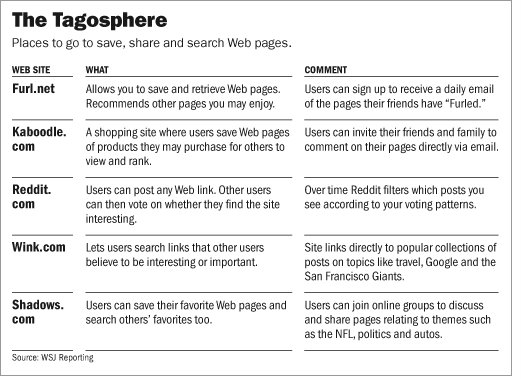
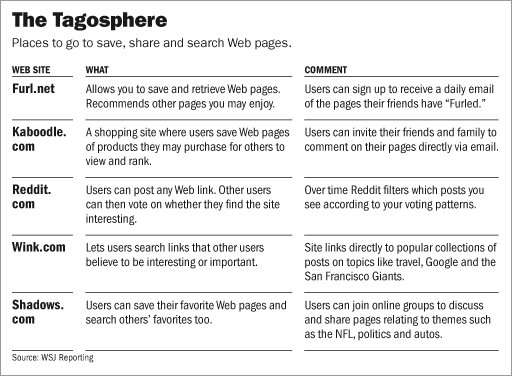
AMERICANS conduct nearly 200 million Internet searches every day. Now, several companies want to make that process better by transforming the way people look for and store information they find online.
The new method, dubbed "tagging," addresses a common complaint of many Internet users -- that searching is often clumsy and inefficient. Web surfers often must sift through multiple pages of search results to find what they are looking for. And retrieving the best sites a second time often means redoing the search or trolling through an unorganized list of sites that you have haphazardly saved in a "favorites" folder.
Tagging, however, can cut through the online clutter to deliver more relevant bits of information. That is because many versions allow users to search only sites that other people have already deemed useful. It also makes it easier to find desired information again. Users says tagging services can simplify online endeavors like shopping for a new road bike or acoustic guitar because they allow a prospective buyer to quickly access saved information.
While tech-heads have been using the method for the past year or so, tagging is now moving into the mainstream. Silicon Valley heavyweights -- along with a number of new upstarts -- are now putting major resources into developing tagging services. Last month, Yahoo Inc. bought the popular tagging site Del.icio.us (pronounced "delicious"). Now, the Sunnyvale, Calif., company says it plans to allow Del.icio.us users to access their tagged links through My Web 2.0, Yahoo's own tagging site.
One new site, Shadows.com, allows individuals to save their favorite Web sites under keywords that others can also search. The site, launched last October by the co-founders of Pluck Corp., based in Austin, Texas, attracts more than 275,000 unique monthly visitors, according to comScore Networks. Last week, iLor LLC of Lexington, Ky., launched PreFound.com. Like other bookmarking sites, it allows its users to upload pages they want to save into their own profiles or share them with the public.
Yahoo's Flickr.com, which allows anyone to upload photos from their camera phone or computer to the Web and then store them in a digital album that others can search by the keyword tags, is another early tagging success.
While tagging is still new and the method does have limitations, analysts are predicting further growth in "the tagosphere" as new companies crop up to grab a share of the nearly $15 billion online-advertising market. Tagging sites are free to use, but some run advertisements which display small snippets of ad text targeted to the terms a user is searching for or other words on the page.
Tagging sites are increasingly transitioning beyond places individuals go to for retrieving their favorite Web pages to sites they visit first when they want to search the Internet. That means they are beginning to compete directly with search behemoths such as Google and Yahoo. A Google Inc. spokesman says the company doesn't comment on its competition. "These systems are really coming into the mass market," says Caterina Fake, director of Yahoo Search technology.
Demand for the new sites reflect many Web surfers frustration with current search technology. The major search engines are all built around different algorithms that attempt to determine the most relevant sites for a particular search. But only 17% of Internet users say they always find what they are looking for when they use a search engine, according to a 2005 report from the Pew Internet & American Life Project. In November, Americans conducted more than five billion online searches, up 9% from the previous year, according to comScore Networks.
Tagging services have multiple uses. First, they allow Web surfers to save hundreds (or even thousands) of favorite Web pages under key words. The technology is named after the keyword "tags" users associate with each page they want to save. (For example, a Web page featuring ski goggles could be saved under the tag, skiing.) For individual users, tagging makes their own favorite pages easy to search and retrieve. Unlike storing addresses in a "favorites" folder on your computer, tagged pages are stored on the Web and accessible from any computer. A tagging site also lets you search among all your stored pages by key word, eliminating the need to scroll through dozens of sites and remember the order in which your links are saved.
There are two main ways to tag a Web site. Del.icio.us, for instance, will ask you to enter the Web address of the site you want to save into a field on its page and to click "save." The site, along with many others, also allows you download a toolbar to your desktop. While Web surfing, you can add pages to your account simply by clicking on the toolbar.
Companies say the greatest benefit of tagging -- and the reason why big Internet companies are adopting it -- is that tagging sites often allow users to make their list of tags and sites available to and searchable by either a closed community of friends and family or all other Web surfers. So, instead of searching the entire Web, users can limit their forays to an edited universe of pages others have already tagged as interesting or helpful. Also, many tagging services include the kind of social-networking features that have made sites such as MySpace.com and Friendster so popular: Users can post comments or vote on the usefulness of sites that others have tagged.
While most tagging sites allow you to tag pages on any topic, some sites are built around a theme. Kaboodle.com is a tagging site for the online shopper that allows users to save Web pages displaying items they are considering purchasing. Through buttons they add to their Internet toolbar, users can turn any product Web page, from a book on Amazon.com to clothing on eBay, into an entry on their personal Kaboodle page where others can rate and comment on the item.
There are some downsides to the new sites. Unlike a typical search engine, the effectiveness of tagging services depends on the quality and quantity of the people who save pages to them. Also, generally users have to use the same tags in order for a search to capture all the relevant pages. (For example, if you search for sites under the tag "winter boots," you could miss out on applicable pages that were tagged under "shoes.")
Some users complain that not enough people are tagging for it to be worth their while. Indeed, even the most popular sites generate less than 1% of Google's monthly traffic. But they're growing fast: Some, such as Shadows.com, are doubling their number of sign-ups every month.
When Mark Johnson of San Jose, Calif., wants to learn more about a company that he hears about in the news, he has largely stopped going to Yahoo, where he says it may take him up to ten different searches to find what he needs. Instead, the 27-year-old, who works for Internet start-up Kosmix.com, goes to Wink.com, a site that lets users search pages others have already tagged. While he still visits Yahoo, often by default, he says he uses Wink.com for restaurant recommendations and for other searches where human recommendations play an important role.
43 Things I (or you) might want to do this year
43 Things is a cool site. It's ideal for tracking and working on your personal progress to learn new things. I like to think of it as tracking play. Remember your goals for the day as a child? Build a fort. Make an ashtray out of the batch of clay you found by the creek? Climb the cliff in the park. Every time you did something on your mental daily goals list you learned something and felt a sense of accomplishment. You grew.
The basic concept of 43 Things is that "people have known for years that making a list of goals is the best way to achieve them. Why is that? First, getting your goals in writing can help you clarify what you really want to do. You might find you have some important and some frivolous goals. That is OK."
This Web site gives you space for 43 entries on your list. Not every item needs to be earth shattering. Learning is incremental and you can grow a little bit at a time and suddenly realize you're competent in something new. With this site you can discover from others registered on the site the many options of what you can choose to do as well as find others who share your interest. It's a way of engaging in life itself. The goal of the site is to let you make your list, edit it, get inspired and share your progress. As you achieve a goal you've listed you can click on the "I've done this" button and share a story about how you did it.
This site appears to be ready-made for those of us learners who like to engage in self-discovery and tracking our progress. I think that we're a profession of inveterate list makers and love to tick off our accomplishments. So here's my suggestion this month. Beware: this could be a yearlong or lifelong project! I want you to go to 43 Things (See the URL in the sidebar), register and list what you want to accomplish this year. You can make it private or share it with others. Just try it! Can't think of 43 things to do? Here are a few suggestions of simple things to try:
1. Take a digital picture with a camera and/or phone and download it to your PC.
2. Register at Blogger and start a blog. Post every once in a while and add a photo.
3. Register at Bloglines and aggregate your blog and RSS subscriptions into one reader. Check out what other blogs align with your interests.
4. Look at Facebook and see the next generation of social networking.
5. Set up a Flickr account and post a few of digital photos online. Tag and annotate them.
6. Look at LibraryElf and see the potential for personal library tools.
7. Check out LibraryThing and catalogue a few books from your personal collection.
8. Register at MSN Photo Album and build an album to share with friends, family, or colleagues.
9. Check out Myspace and see how this service has become so huge globally.
10. Have some fun with the links on the Generator Blog.
11. Download Firefox and compare it to Explorer and Opera.
12. Research bookmarklets and try a few.
13. Revisit Yahoo! and remind yourself why it is visited more than Google.
14. Learn about iFILM and viral video.
15. Get a PubSub account and start searching the future.
16. Make a map of all the countries or states you've been to at Visited Countries.
17. Experiment with some sound and picture search engines like Podscope.
18. Try some new Web search engines like Exalead, Wink, Gravee, Clusty, Mooter, Kartoo, etc., or others you can find at Search Engine Watch's list.
[ILLUSTRATION OMITTED]
19. Learn more about visual display tools like Grokker.
20. Check out Google Base and see what the fuss is all about.
21. Register with NetFlix and rent a movie. Learn how to deal with streaming media.
22. Get a Del.icio.us account and play with social bookmarking and tags.
23. Play with Blinkx and learn about searching TV shows, video and podcasts.
24. Try MovieFlix too. There are plenty of free movies here to learn to do this.
25. Set up a Google Picasa account. Post a picture and then edit it.
26. Download an MP3 file to your PC, laptop or phone. Try iTunes, LimeWire, Kazaa, or eDonkey. Look for something that's not music too.
27. Listen to a podcast. There are quite a few about library issues, too.
28. Find your home and your office on Google Maps.
29. Check out your local public library's website. You'll likely find some cool stuff like talking books for that long commute, or classical music collections, or eBooks.
30. Change your ring tone so you don't jump when everyone else's default ring goes off.
31. Visit the Google Labs site regularly.
32. Set up a personalized Google or My Yahoo! page
33. Play with JibJab.
34. Play with Wikipedia. Edit an entry, feel the network.
35. Play with Copernic and extend your searching.
36. Play an online multiplayer game.
37. Take an e-learning course from Click University.
38. Choose any of the above and add your own goals. Include some fun things, too.
I could go on about this forever! Many of you will have already tried a number of the above. They're easy and mostly free. By trying some you may find a serious business use for it too. Many of these sites represent some pretty basic Web and technology skills that will be necessary to survive the next few years. Even if they don't help you at work, they're great party talk, too. This past holiday season I asked every teen and college-age friend and relative I met about the way they used the Web, and many of the links above were tools and services that they considered essential to their lives. It's your entry into the new world of next-generation coworkers.
See! It's easy to try new things. Have fun.
43 Things: What do you want to do with your life?
http://www.43things.com
Blinkx
http://www2.blinkx.com/overview.php
Blogger
http://www.blogger.com/start
Bloglines
http://www.bloglines.com
Click University
http://sla.learn.com/learncenter.asp?id=178409&page=1
Clusty
http://clusty.com
Copernic
http://www.copernic.com/en/products/agent/index.html
Del.icio.us
http://del.icio.us
eDonkey
http://www.edonkey2000.com
Exalead
http://www.exalead.com/search
Facebook
http://www.facebook.com
Firefox
http://www.mozilla.com/firefox
Flickr
http://www.flickr.com
Generator Blog
http://generatorblog.blogspot.com
Google Labs
http://labs.google.com
Google Maps
http://maps.google.com
Google Personal
http://www.google.com/ig
Gravee
http://www.gravee.com
Grokker
http://www.grokker.com
iFILM
http://www.ifilm.com
iTunes
http://www.apple.com/itunes
JibJab
http://www.jibjab.com/Home.aspx
Kazaa
http://www.kazaa.com/us/index.htm
Kartoo
http://www.kartoo.com
LibraryElf
http://www.libraryelf.com
LibraryThing
http://www.librarything.com
LimeWire
http://www.limewire.com
Mooter
http://www.mooter.com
MovieFlix
http://www.movieflix.com
MSN Photo Album
http://communities.msn.com/content/features/photoalbum.asp
Myspace
http://www.myspace.com
My Yahoo!
http://ca.my.yahoo.com
NetFlix
http://www.netflix.com/Default
Picasa
http://picasa.google.com/index.html
Podscope
http://www.podscope.com
PubSub
http://www.pubsub.com
Search Engine Watch list of search engines
http://searchenginewatch.com/links
Stephen's Lighthouse Blog
http://stephenslighthouse.sirsi.com
Visited Countries
http://douweosinga.com/projects/visitedcountries
Wikipedia
http://en.wikipedia.org/wiki/Main_Page
Wink
http://www.wink.com
Yahoo!
The basic concept of 43 Things is that "people have known for years that making a list of goals is the best way to achieve them. Why is that? First, getting your goals in writing can help you clarify what you really want to do. You might find you have some important and some frivolous goals. That is OK."
This Web site gives you space for 43 entries on your list. Not every item needs to be earth shattering. Learning is incremental and you can grow a little bit at a time and suddenly realize you're competent in something new. With this site you can discover from others registered on the site the many options of what you can choose to do as well as find others who share your interest. It's a way of engaging in life itself. The goal of the site is to let you make your list, edit it, get inspired and share your progress. As you achieve a goal you've listed you can click on the "I've done this" button and share a story about how you did it.
This site appears to be ready-made for those of us learners who like to engage in self-discovery and tracking our progress. I think that we're a profession of inveterate list makers and love to tick off our accomplishments. So here's my suggestion this month. Beware: this could be a yearlong or lifelong project! I want you to go to 43 Things (See the URL in the sidebar), register and list what you want to accomplish this year. You can make it private or share it with others. Just try it! Can't think of 43 things to do? Here are a few suggestions of simple things to try:
1. Take a digital picture with a camera and/or phone and download it to your PC.
2. Register at Blogger and start a blog. Post every once in a while and add a photo.
3. Register at Bloglines and aggregate your blog and RSS subscriptions into one reader. Check out what other blogs align with your interests.
4. Look at Facebook and see the next generation of social networking.
5. Set up a Flickr account and post a few of digital photos online. Tag and annotate them.
6. Look at LibraryElf and see the potential for personal library tools.
7. Check out LibraryThing and catalogue a few books from your personal collection.
8. Register at MSN Photo Album and build an album to share with friends, family, or colleagues.
9. Check out Myspace and see how this service has become so huge globally.
10. Have some fun with the links on the Generator Blog.
11. Download Firefox and compare it to Explorer and Opera.
12. Research bookmarklets and try a few.
13. Revisit Yahoo! and remind yourself why it is visited more than Google.
14. Learn about iFILM and viral video.
15. Get a PubSub account and start searching the future.
16. Make a map of all the countries or states you've been to at Visited Countries.
17. Experiment with some sound and picture search engines like Podscope.
18. Try some new Web search engines like Exalead, Wink, Gravee, Clusty, Mooter, Kartoo, etc., or others you can find at Search Engine Watch's list.
[ILLUSTRATION OMITTED]
19. Learn more about visual display tools like Grokker.
20. Check out Google Base and see what the fuss is all about.
21. Register with NetFlix and rent a movie. Learn how to deal with streaming media.
22. Get a Del.icio.us account and play with social bookmarking and tags.
23. Play with Blinkx and learn about searching TV shows, video and podcasts.
24. Try MovieFlix too. There are plenty of free movies here to learn to do this.
25. Set up a Google Picasa account. Post a picture and then edit it.
26. Download an MP3 file to your PC, laptop or phone. Try iTunes, LimeWire, Kazaa, or eDonkey. Look for something that's not music too.
27. Listen to a podcast. There are quite a few about library issues, too.
28. Find your home and your office on Google Maps.
29. Check out your local public library's website. You'll likely find some cool stuff like talking books for that long commute, or classical music collections, or eBooks.
30. Change your ring tone so you don't jump when everyone else's default ring goes off.
31. Visit the Google Labs site regularly.
32. Set up a personalized Google or My Yahoo! page
33. Play with JibJab.
34. Play with Wikipedia. Edit an entry, feel the network.
35. Play with Copernic and extend your searching.
36. Play an online multiplayer game.
37. Take an e-learning course from Click University.
38. Choose any of the above and add your own goals. Include some fun things, too.
I could go on about this forever! Many of you will have already tried a number of the above. They're easy and mostly free. By trying some you may find a serious business use for it too. Many of these sites represent some pretty basic Web and technology skills that will be necessary to survive the next few years. Even if they don't help you at work, they're great party talk, too. This past holiday season I asked every teen and college-age friend and relative I met about the way they used the Web, and many of the links above were tools and services that they considered essential to their lives. It's your entry into the new world of next-generation coworkers.
See! It's easy to try new things. Have fun.
43 Things: What do you want to do with your life?
http://www.43things.com
Blinkx
http://www2.blinkx.com/overview.php
Blogger
http://www.blogger.com/start
Bloglines
http://www.bloglines.com
Click University
http://sla.learn.com/learncenter.asp?id=178409&page=1
Clusty
http://clusty.com
Copernic
http://www.copernic.com/en/products/agent/index.html
Del.icio.us
http://del.icio.us
eDonkey
http://www.edonkey2000.com
Exalead
http://www.exalead.com/search
http://www.facebook.com
Firefox
http://www.mozilla.com/firefox
Flickr
http://www.flickr.com
Generator Blog
http://generatorblog.blogspot.com
Google Labs
http://labs.google.com
Google Maps
http://maps.google.com
Google Personal
http://www.google.com/ig
Gravee
http://www.gravee.com
Grokker
http://www.grokker.com
iFILM
http://www.ifilm.com
iTunes
http://www.apple.com/itunes
JibJab
http://www.jibjab.com/Home.aspx
Kazaa
http://www.kazaa.com/us/index.htm
Kartoo
http://www.kartoo.com
LibraryElf
http://www.libraryelf.com
LibraryThing
http://www.librarything.com
LimeWire
http://www.limewire.com
Mooter
http://www.mooter.com
MovieFlix
http://www.movieflix.com
MSN Photo Album
http://communities.msn.com/content/features/photoalbum.asp
Myspace
http://www.myspace.com
My Yahoo!
http://ca.my.yahoo.com
NetFlix
http://www.netflix.com/Default
Picasa
http://picasa.google.com/index.html
Podscope
http://www.podscope.com
PubSub
http://www.pubsub.com
Search Engine Watch list of search engines
http://searchenginewatch.com/links
Stephen's Lighthouse Blog
http://stephenslighthouse.sirsi.com
Visited Countries
http://douweosinga.com/projects/visitedcountries
Wikipedia
http://en.wikipedia.org/wiki/Main_Page
Wink
http://www.wink.com
Yahoo!
Subscribe to:
Posts (Atom)